
Audio Moderation
Audio moderation for live voice and recorded sound
Audio carries harm that text filters never see. Harassment escalates by tone, threats hide in sarcasm, and contact details get spoken aloud to dodge written rules. Lasso moderates live voice chat and recorded audio in one pipeline, combining voice-native detection with transcription, so spoken violations are caught before they reach your users.
Two detection capabilities for every type of audio risk
Voice Moderation
Detect harassment, hate, threats, and escalation in live voice chat. Voice-native analysis reads tone and intent in the moment, powered by Modulate ToxMod.
Learn more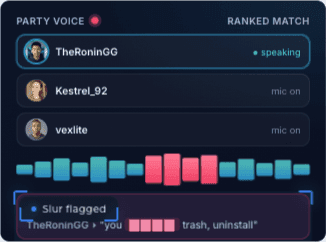
Audio Transcription
Convert voice notes, podcasts, and live audio rooms to text and moderate the transcript for hate, threats, PII, and profanity, with a timestamp on every segment.
Learn more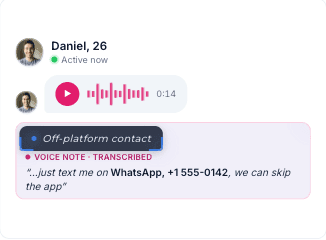
Lasso's four-layer audio moderation pipeline
ML Detection
Audio enters the pipeline. Live voice is scored voice-native for tone, intensity, and escalation. Recorded audio is transcribed per segment and classified for hate, threats, PII, and profanity. Clear violations are caught here; ambiguous events move on.
See Lasso in actionRanked match · voice● live
Custom Rules
Your rules applied to every audio event. Trash talk that passes in one community fails in another. Custom rules turn raw detection into decisions that match your policies, using the same engine as your text and image moderation.
See Lasso in actionVoice event · 0:42scored
AI Moderator
The AI Moderator handles what rules can't cover. The same words mean different things in a competitive game lobby and a one-to-one dating call. It reads context and intent, then decides or routes to human review.
See Lasso in actionHuman Review
Borderline events reach your team with everything they need: the audio clip, the detection signals, the AI Moderator's read, and the flagged timestamp. Moderators play the exact moment, decide, and every decision retrains the system.
See Lasso in actionAudio moderation across industries

Slurs and verbal harassment in competitive party chat. Escalating abuse between players in matchmaking lobbies. Coordinated voice raids targeting streamers and individual players.
- Players shout slurs in competitive voice chat the moment text is moderated.
- Verbal harassment escalates between players in matchmaking and team channels.
- Coordinated voice raids flood proximity chat to target streamers and individuals.

Predatory dialogue moving into voice notes. Coded language for illegal services spoken to dodge text filters. Heated voice arguments escalating into spoken threats.
- Users move grooming and predatory dialogue into voice notes to avoid text moderation.
- Coded language for drug or service sales spoken aloud in voice channels.
- Heated voice exchanges escalate into spoken personal threats in real time.

Spoken WhatsApp and Telegram handles to move matches off platform. Verbal solicitation and threats in one-to-one voice calls. Unsolicited explicit content delivered as voice notes.
- Matches recite WhatsApp or Telegram handles in voice calls to move off platform.
- Verbal solicitation, harassment, and threats delivered in one-to-one voice.
- Voice DMs used to send unsolicited explicit content.

Spoken solicitation and age-falsification in audio. AI-cloned voices impersonating performers. Non-consensual audio attached to uploaded content.
- Spoken solicitation and age-falsification hidden in audio tracks.
- AI-cloned voices used to impersonate performers or fabricate consent.
- Non-consensual recorded audio attached to uploaded content.

Contact details and payment handles spoken in product voiceovers. Coded spoken language for prohibited items. Scam voice messages routing buyers to external payment.
- Sellers speak contact and payment details in product video voiceovers to leak transactions.
- Prohibited and regulated items described with coded spoken language.
- Scam voice messages in buyer-seller chat direct payment off-platform.

Speakers using slurs on a live broadcast feed. Coordinated voice raids during streams and festivals. Attendees' personal data read aloud on air.
- Festival and panel speakers say slurs or threats on live broadcast audio.
- Coordinated voice raids flood live streams during events.
- Attendees' phone numbers or addresses are read aloud on air.

Hate speech spoken in live audio rooms. AI-voice deepfakes spreading misinformation. Personal data read aloud to dox users in audio spaces.
- Hate speech spoken aloud in live audio rooms reaching broadcast audiences.
- AI-cloned voices of public figures used to spread misinformation.
- Personal data read aloud to dox users in audio clips and rooms.

Verbal abuse in audio comments and voice-note replies. Spoken misinformation in user audio submissions. Personal data of journalists read aloud in user audio.
- Audio comments and voice-note replies carry verbal harassment and personal attacks.
- User-submitted audio spreads spoken misinformation contradicting the article.
- Personal data of journalists or subjects is read aloud in user audio.
Audio moderation, answered
Audio moderation is the process of analyzing spoken and recorded sound for policy violations before it reaches other users. It covers live voice chat, voice notes, podcasts, and audio rooms, detecting harassment, hate speech, threats, escalation, profanity, and personal data spoken aloud.
Audio passes through four layers. ML detection scores live voice in real time and transcribes recorded audio for classification. Custom rules apply your platform policies. A context-aware AI moderator resolves edge cases. Human reviewers handle the rest, and every decision retrains the system.
Voice moderation handles live voice chat such as in-game voice and voice calls, using voice-native detection in real time. Audio transcription handles recorded and async audio such as voice notes, podcasts, and audio rooms by transcribing then moderating the transcript. Both run through the same pipeline.
Voice-native detection reads tone, intensity, and escalation directly from the audio. Sarcasm, coded harassment, and calm-voiced threats register in the signal before words are transcribed. Lasso runs voice-native detection on live voice, then routes those signals into the four-layer pipeline.
Accuracy depends on the content. Clear violations are caught in the first ML layer, while context-dependent cases pass through custom rules, a context-aware AI moderator, and human review. This four-layer approach is how Lasso automates 99.9% of moderation decisions, with the remaining edge cases routed to human review.
Live voice chat is scored in the moment, with violations flagged during the conversation. Live audio rooms are transcribed and moderated segment by segment as the session runs, so flagged events reach the queue without waiting for the session to end.
Lasso detects harassment and bullying, hate speech, threats and violent speech, adult and sexual content, grooming patterns, escalation between users, profanity, and personal data spoken aloud. Custom rules let you add platform-specific triggers on top.
Voice moderation works across 18 languages and audio transcription across 12 languages. Language is detected automatically from the audio, and your custom rules can apply per language.
Yes. The custom rules layer lets you set sensitivity, escalation thresholds, blocklists, and word lists per community. The same spoken event can pass in one space and be blocked in another, using the same rule engine as your text and image moderation.
Send audio through Lasso's API or connect your voice provider, then configure rules, queues, and actions in the dashboard. Audio events appear in the same review queue as your text and image moderation, so there is no separate tool to manage.
Only for a fraction of events. Lasso automates 99.9% of decisions and routes borderline cases to your team with the audio clip, the signals, the AI moderator's read, and the timestamp. Moderators play the moment and decide, and every decision retrains the system.
Yes. Lasso moderates text, image, video, and audio through the same four-layer pipeline. Each content type has its own detection capabilities but shares the same rule engine, AI moderator, and human review workflow.
Lasso includes GDPR-compliant data handling, built-in DSA compliance reports, full audit logs of every moderation decision, and configurable data retention for audio. Spoken personal data such as phone numbers and emails is detected before it spreads.
Hear what your filters are missing
Moderate live voice and recorded audio in one pipeline, alongside your text and image content.