What is the Perspective API

Paul van Schie
Head of Go-to-Market
What is the Perspective API | For nearly a decade, platforms like the New York Times and Reddit have relied on the Perspective API to keep toxic comments in check.
At its peak, it handled roughly 500 million requests per day. But Google has announced the API will shut down after December 2026.
This article covers what the Perspective API is, what its sunsetting means for content moderation, and what to look for in an alternative.
The TLDR;
- The Perspective API is a free Google/Jigsaw API service that scores text for toxicity on a 0–1 scale using machine learning.
- It's been used by 1,000+ platforms including the NYT, Reddit, and Wikipedia.
- The API is shutting down December 31, 2026 with zero migration support from Google.
- Key weaknesses: can't understand sarcasm or context, has documented bias issues, and offers no policy customization.
- Modern AI-based alternatives now exist that go well beyond what Perspective API could do: see our full guide.
Table of Contents
What is the Perspective API?
The Google Perspective API is an open-source content moderation API that scores text, based on how toxic it's likely to be perceived. You send a comment to the API, and it returns a probability score between 0.0 (very unlikely to be perceived as toxic) and 1.0 (very likely).
The API doesn't determine whether a comment is objectively harmful. It predicts the impact: how likely it is that a human reader would consider the comment toxic, threatening, insulting, or otherwise problematic?
The tool was built by Jigsaw, a technology unit within Alphabet (Google's parent company). It launched in February 2017, initially trained on moderation data from The New York Times.
Since then, the API has grown to serve over 1,000 partners across news publishers, social platforms, gaming communities, and educational tools. Basically, it has largely moderated the web since its deployment.
The Perspective API at a glance
- Built by: Jigsaw (Google/Alphabet)
- Launched: February 2017
- Cost: Free to use, expensive to moderate as human moderation is essential.
- Peak usage: ~500M requests/day, 1,000+ partners
- Status: Sunsetting after December 31, 2026
Copyright: Google Perspective API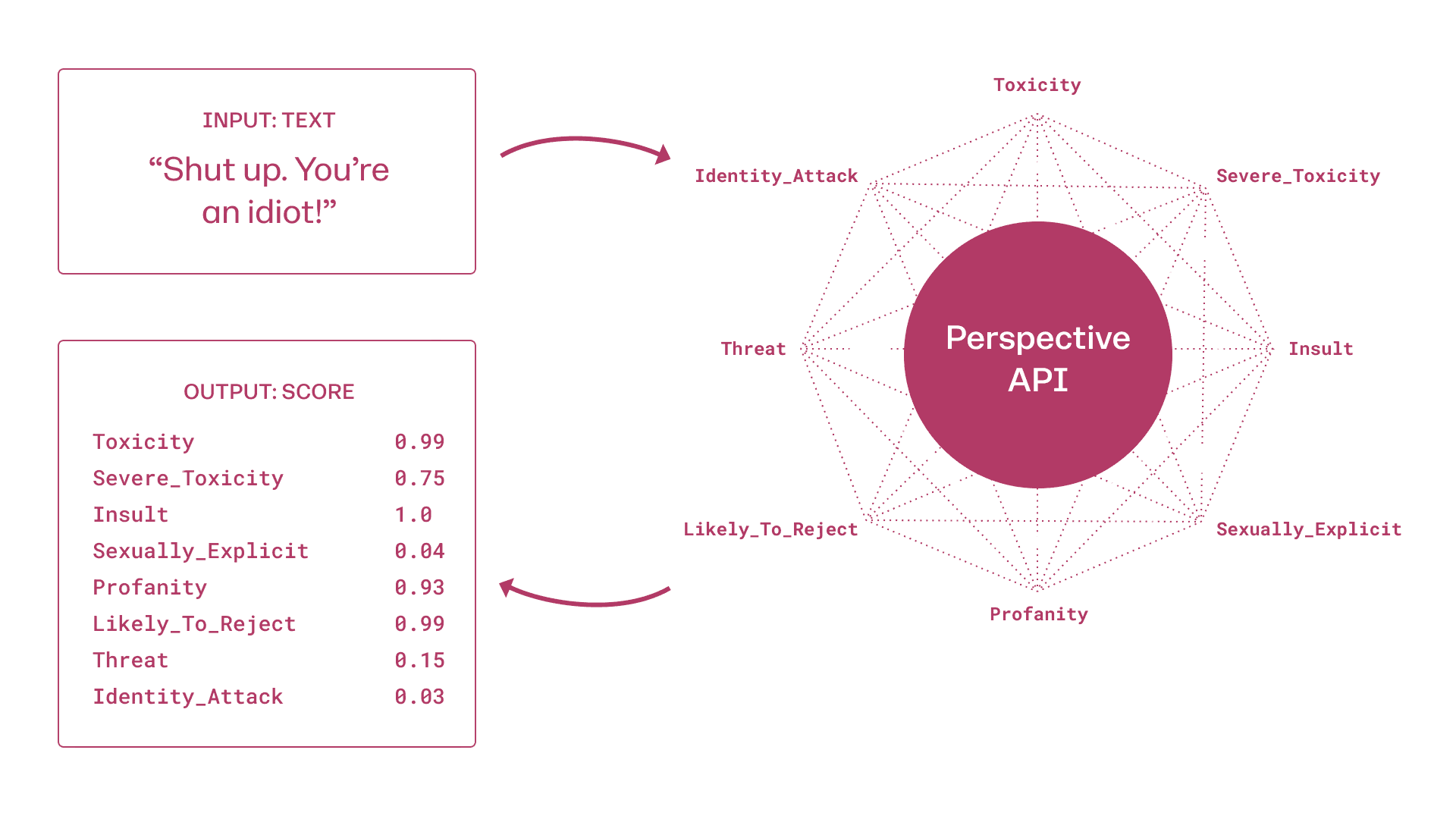
Consequences of the sunsetting for content moderation
The sunsetting unveils a real shift in the content moderation landscape. When Perspective launched in 2017, it was one of the only accessible, free tools for ML-based moderation.
Today, a new generation of AI-powered tools has emerged that understands context, adapts to specific platform policies, and handles multiple content types.
The need for content moderation hasn't gone away. If anything, the rise of AI-generated content is making it more urgent than ever.
The Perspective API Is Sunsetting: What You Need to Know
This is arguably the most important thing to know about the API today.
Key Dates
- Service active until: December 31, 2026
- New usage/quota requests accepted until: February 2026
- Migration support from Google: None provided
- Stated reason: "AI capabilities have evolved, and there is now less demand for a standalone tool specific to this area."
If you're currently using the Perspective API, you have until the end of 2026 to migrate. No migration tool or transition path is being provided, so teams need to evaluate alternatives and switch independently. Existing third-party integrations like the Discourse plugin and Drupal module are being deprecated.
Looking for a Perspective API replacement?
We break down how the API works, why it's being retired, and the top alternatives you can migrate to. With a step-by-step comparison to help you choose the right fit.
Read the Full GuideHow does the Perspective API work?
Most describe the API as "using machine learning" and leave it at that. Here's what's actually happening under the hood.
Machine learning under the hood
The API runs on Convolutional Neural Networks (CNNs), a specific type of deep learning model trained on large datasets of online comments. These comments come from sources like The New York Times, Wikipedia talk pages, and online discussion forums. Thousands of human reviewers labeled them on dimensions like toxicity, threats, and insults.
The model learns patterns from those human-labeled examples. When you send new text to the API, it compares the input against those learned patterns and returns a probability score.
Here's how to read the score: if a comment receives a toxicity score of 0.78, that means approximately 78% of human raters would likely consider this comment toxic. It's not a binary "toxic or not toxic" verdict. Rather, it's a confidence level.
Jigsaw has published research papers on the model architecture and periodically retrains the models to improve accuracy and reduce bias.
Available attributes
The Perspective API doesn't just score for toxicity. It evaluates text across multiple attributes, each representing a different dimension of potentially harmful content. These are ALL the attributes:
| Attribute | Status | What It Detects |
|---|---|---|
| TOXICITY | Production | Rude, disrespectful, or unreasonable content |
| SEVERE_TOXICITY | Production | Very hateful, aggressive, or deeply disrespectful content |
| IDENTITY_ATTACK | Production | Negative or hateful targeting of someone's identity |
| INSULT | Production | Insulting, inflammatory, or negative language |
| PROFANITY | Production | Swear words, curse words, obscene language |
| THREAT | Production | Intent to inflict pain, injury, or violence |
| SEXUALLY_EXPLICIT | Experimental | References to sexual acts or anatomy |
| OBSCENE | Experimental | Obscene or vulgar language |
| SPAM | Experimental | Irrelevant, promotional, or repetitive content |
| ATTACK_ON_COMMENTER | Experimental | Attack directed at another commenter |
| ATTACK_ON_AUTHOR | Experimental | Attack directed at the content's original author |
| UNSUBSTANTIAL | Experimental | Trivial or low-effort comment |
Production attributes are stable, well-tested, and available in 18+ languages.
Experimental attributes are trained on more limited data (primarily from the NYT) and are mostly English-only.
In March 2025, Jigsaw also introduced experimental "bridging attributes" that detect constructive conversation signals like curiosity, reasoning, and personal stories. This marked a shift from only flagging negative content to also recognizing positive contributions.
Supported languages
Production attributes like TOXICITY and SEVERE_TOXICITY are available in 18+ languages, including English, Spanish, French, German, Portuguese, Italian, Russian, Turkish, Arabic, Chinese, Japanese, Korean, Hindi, and Indonesian.
Accuracy varies by language, with English performing strongest. Experimental attributes are mostly limited to English.
The two API methods
The Perspective API provides two primary methods for interacting with its models:
AnalyzeComment is the primary method. You send text and specify which attributes you want scored. The API returns probability scores for each one. Key request fields include comment.text (the content to analyze), requestedAttributes (which scores you want), languages (optional language hint), and doNotStore (a privacy flag).
SuggestCommentScore lets developers submit feedback when they disagree with a score. This feedback loop helps improve the model's accuracy over time — a feature most developers overlook.
Common use cases
There are four primary integration patterns for the Perspective API:
1. Automated comment moderation The most common implementation: the API scores each comment at submission time, and the platform takes action based on the result. A simple threshold framework to start with:
| Score Range | Suggested Action |
|---|---|
| 0.0 – 0.3 | Likely safe — auto-approve |
| 0.3 – 0.7 | Ambiguous — queue for human review |
| 0.7 – 1.0 | Likely toxic — hold or auto-remove |
These are starting points, not rules. Every community has different norms, and thresholds should be tuned based on your own moderation data.
2. Real-time user nudges
Instead of silently blocking content, some platforms show authors a warning before they post: "This comment may be perceived as toxic, are you sure?" The Discourse forum plugin uses this approach. It gives users a chance to self-correct, which can meaningfully reduce the volume of toxic submissions without any content being removed.
3. Moderator triage
For platforms with moderation teams, the API can sort incoming comment queues by toxicity score. This lets human moderators focus on the most harmful content first. The New York Times used this approach to more than double the number of articles open to reader comments.
4. Research and community analytics
Academics and platform teams use the Perspective API to study toxicity patterns, measure community health over time, and track behavioral trends across large datasets.
4 Ways Teams Use The Perspective API
Automated Moderation
Auto-flag or remove comments that exceed toxicity thresholds, reducing manual review volume by up to 90%.
Real-Time User Nudges
Prompt users to reconsider before posting potentially harmful content, improving community tone proactively.
Moderator Triage
Prioritize the review queue by toxicity score so human moderators focus on the most critical content first.
Research & Analytics
Measure toxicity trends over time to understand community health and the impact of policy changes.
Limitations and Known Issues
Google's Perspective API was a pioneer, but it has well-documented limitations worth understanding before you build around it.
Context blindness is the most significant issue. The API analyzes text in isolation without understanding sarcasm, intent, or conversational context. A comment like "I could kill for a pizza right now" can score high on THREAT despite being completely benign. Jigsaw's own guidance: use the API to assist human moderators, never to replace them entirely.
Bias concerns are also well-documented. Research has shown that text in African American Vernacular English (AAVE) and content containing LGBTQ+ terminology can be disproportionately flagged as toxic, even in neutral or positive contexts. Jigsaw has worked to address these biases through retraining, but no model is completely bias-free.
Language accuracy varies significantly. English achieves the best performance, but other languages can score considerably lower in accuracy. Experimental attributes are mostly English-only, trained primarily on NYT data.
No policy customization. The API gives you a generic toxicity score. You can't tell it "profanity is fine on our platform, but personal attacks aren't." Every platform gets the same definition of toxic, regardless of community norms.
Privacy considerations. By default, submitted text may be stored by Google under its standard Privacy Policy. Use the doNotStore flag in your requests if your platform handles sensitive data or is subject to GDPR.
For a deeper analysis of these limitations, and how modern moderation tools address them, see our complete Perspective API guide.
Looking for a replacement of the Perspective API?
We break down how the API works, why it's being retired, and the top alternatives you can migrate to. With a step-by-step comparison to help you choose the right fit.
Read the Full GuideFrequently Asked Questions
Is the Perspective API free?
Yes. The Perspective API is free to use with a default rate limit of 1 query per second. Developers can request increased quotas. The API remains free until it shuts down after December 31, 2026. The free API does come at the cost of heavy human moderation, which needs to implemented in most cases.
Is the Perspective API shutting down?
Yes. Google's Jigsaw team announced that the Perspective API is sunsetting and will no longer be available after December 2026. No direct migration support is being offered. If you're a current user, we recommend starting your evaluation now. Our complete migration guide covers every alternative in detail.
What languages does the Perspective API support?
Production attributes (TOXICITY, SEVERE_TOXICITY, IDENTITY_ATTACK, INSULT, PROFANITY, THREAT) support 18+ languages, including English, Spanish, French, German, Portuguese, Russian, Arabic, Chinese, Japanese, and Korean. Experimental attributes are mostly limited to English.
How accurate is the Perspective API?
Accuracy varies by language, attribute, and context. English achieves roughly 80–85% accuracy, while other languages can drop to 60–75%. The API performs best on overt toxicity and struggles with sarcasm, irony, slang, and culturally specific language.
What's the difference between TOXICITY and SEVERE_TOXICITY?
TOXICITY flags comments that are rude, disrespectful, or likely to make someone leave a conversation — it casts a wider net. SEVERE_TOXICITY is a stricter filter that only catches very hateful, aggressive, or deeply disrespectful content. Use SEVERE_TOXICITY if you want fewer false positives, with the trade-off that it may miss borderline cases.
What are the best alternatives?
The best replacement depends on your platform, scale, and requirements. Options range from modern LLM-based moderation platforms (like Lasso Moderation) to free basic classifiers (OpenAI Moderation), enterprise cloud services (Azure, AWS), and open-source models. See our full alternatives comparison for a detailed breakdown of each.
What's the difference between the Perspective API and the Google Cloud Natural Language API?
They're separate products. Google Cloud Natural Language's moderateText method is a different service that will continue operating after the API shuts down, though it has lower accuracy and different pricing. It's covered in our alternatives guide.
How Lasso Moderation Can Help
At Lasso, we believe that online moderation technology should be affordable, scalable, and easy to use. Our AI-powered moderation platform allows moderators to manage content more efficiently and at scale, ensuring safer and more positive user experiences. From detecting harmful content to filtering spam, our platform helps businesses maintain control, no matter the size of their community.
Book a demo here.
Want to learn more about Content Moderation?
Learn how a platform like Lasso Moderation can help you with moderating your platform. Book a free call with one of our experts.
 Lasso Moderation
© 2026. All rights reserved.
