The Perspective API: The complete guide to finding an alternative

Ruud Visser
Founder & CEO
For nearly a decade, developers have turned to Google's Perspective API as a solution for online toxicity. This free API automatically detects toxic content in real-time.
Its value cannot be underestimated, as toxicity drives users away from platforms, shutting down comment sections, and creating hostile environments that stifle healthy conversation.
However, Google has recently announced that the API is sunsetting as of December 2026.
The TLDR;
- Google's Perspective API is ending: it shuts down December 31, 2026 with zero migration support.
- It had limitations anyway: Can't tell "f* you" from "f* yeah," over-flags LGBTQ+ terms and Black English, and forces everyone into the same rigid categories.
- Technology has evolved: New AI solutions understand context and intent instead of just pattern-matching. They can learn and apply your specific policies rather than applying generic toxicity scores.
- Your alternatives range widely: Modern LLM-based tools, free basic classifiers, enterprise cloud services, and traditional ML replacements, all with their own considerations.
Table of Contents
The Perspective API - Introduction
The December 2026 deadline may seem distant, but migrating content moderation systems takes planning, testing, and careful execution.
Whether you're a current user facing this deadline or a developer evaluating content moderation solutions, this guide helps you understand what the Perspective API is and what alternatives will serve you better in 2026 and beyond.
What you'll learn:
- What the Perspective API is and its most common use cases
- Key benefits that made it popular and critical limitations to understand
- What capabilities you need in any alternative solution
- Comprehensive comparison of viable alternatives for migration
- How to choose the right solution for your specific needs
2. What is the Google Perspective API?
Overview
The Google Perspective API is a free, machine learning-powered API that analyzes text and returns probability scores that indicate how likely a comment is to be perceived as toxic or harmful.
It was created by Jigsaw, Google's technology incubator focused on online threats. The API scores text on a 0-1 toxicity scale where 0 means unlikely to be toxic and 1 means very likely to be toxic.
Copyright: Google Perspective API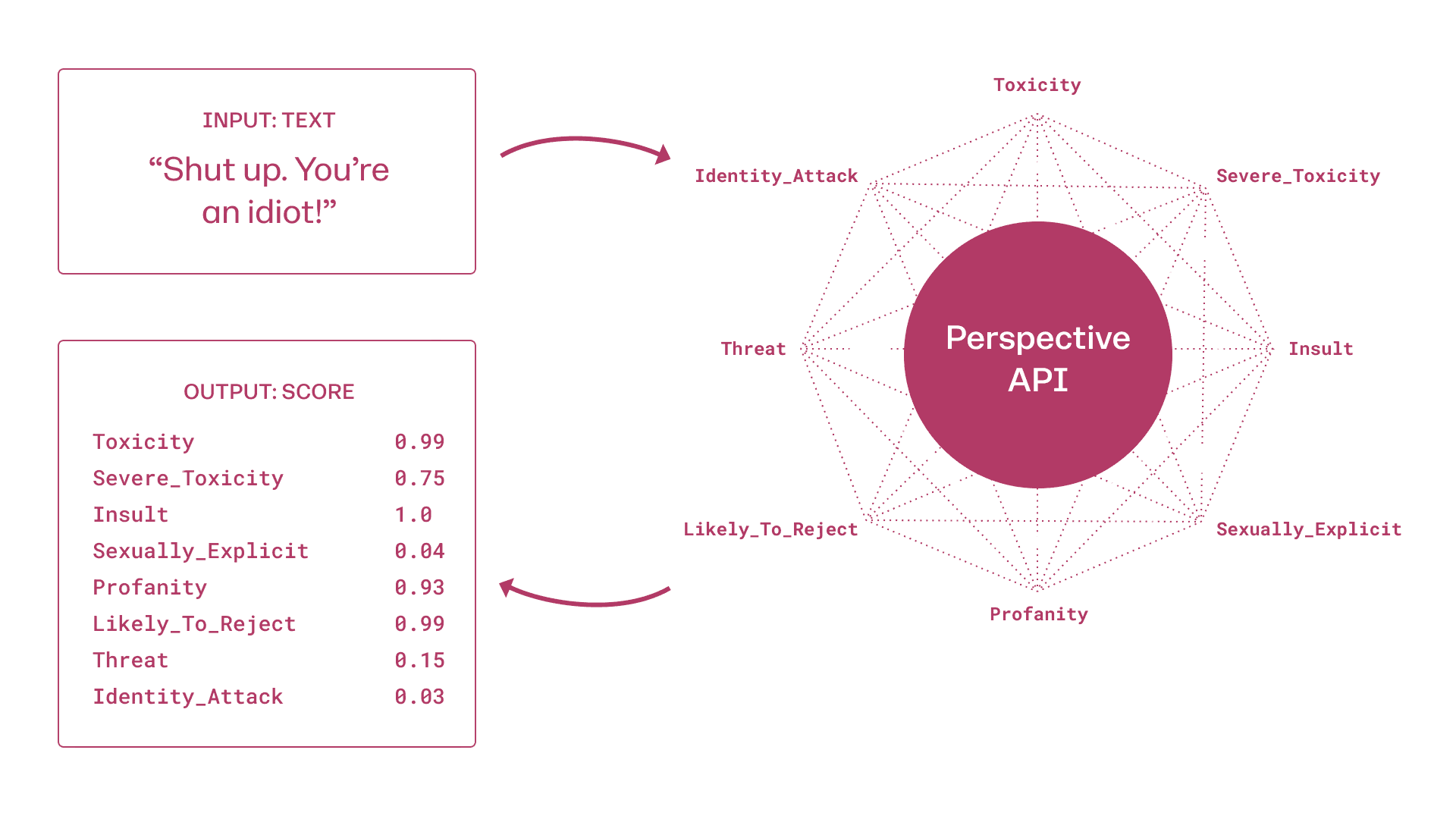
Common use cases
The Perspective API has been deployed across diverse platforms for several key applications:
Real-Time comment moderation
News publishers like The New York Times use the Perspective API to pre-screen comments before publication, automatically filtering toxic content while allowing constructive discussion. Comments scoring above a threshold (typically 0.6-0.8) are flagged for human review or auto-hidden.
Gaming chat filtering
Gaming platforms integrate the Perspective API into in-game chat systems to detect harassment and toxic behavior in real-time, helping maintain healthier gaming communities without requiring constant human moderation.
Social media reply protection
Content creators and brands use the Perspective API to filter replies on social media posts, hiding toxic responses from public view while allowing legitimate criticism and discussion.
Educational platform safety
Schools and educational platforms employ the Perspective API to monitor student discussions and assignment comments, protecting minors from cyberbullying and maintaining respectful academic discourse.
Perspective API Logo.png
Key benefits
The Perspective API became popular for several compelling reasons:
Free to use: Unlike most content moderation APIs, Perspective is completely free (with default rate limits of 1 query per second, expandable with approval). This democratized access to ML-powered moderation for developers and small platforms. ML-Powered intelligence: Moving beyond simple keyword filtering, Perspective uses neural networks trained on millions of human-labeled comments. It can detect toxic content even with creative misspellings or coded language.
Easy integration: As a simple REST API, Perspective requires minimal technical overhead to implement. Send text via HTTP request, and receive toxicity scores in JSON format. There is no complex ML infrastructure needed.
Multiple detection attributes: Beyond basic Toxicity scoring, Perspective offers attributes for (severe) toxicity, insults, threats, profanity, and identity attacks.
Google/Jigsaw credibility: The Perspective API carried institutional trust and ongoing research support (until now).
Widely considered industry standard: For years, the Perspective API was the go-to solution for content moderation, recommended in developer forums, integrated into popular platforms, and cited in academic research as the benchmark for ML-powered toxicity detection.
Multilingual support: Unlike simple keyword filters limited to one language, the Perspective API supports multiple languages including English, Spanish, French, German, Portuguese, and more. This makes the API viable for global platforms.
Critical limitations
While the Perspective API pioneered ML-based moderation, it has significant limitations that matter when choosing alternatives:
1. Context blindness
The Perspective API analyzes text in isolation without understanding broader context, sarcasm, or intent. A comment like "Oh great, another brilliant idea from management" might score as toxic despite being harmless workplace sarcasm. Reclaimed language used positively within communities (e.g., "queer pride" in LGBTQ+ spaces) often triggers false positives. Try it yourself with our demo read.
2. Systematic biases
Academic research has documented concerning biases in the Perspective API: LGBTQ+ terminology flags higher even in neutral or positive contexts. African American Vernacular English (AAVE) scores systematically higher than equivalent Standard English. Mentions of identity groups (race, religion, disability) elevate scores regardless of sentiment. These biases stem from training data patterns and can create disparate censorship of marginalized voices.
3. Fixed categories
The Perspective API's toxicity/insult/threat model is rigid and one-size-fits-all. You cannot customize it to match your specific community guidelines, cultural context, or platform values. Every platform gets the same toxicity definition regardless of their unique needs.
4. Language limitations
While Perspective supports multiple languages, accuracy varies dramatically. English achieves roughly 80-85% accuracy, but other languages perform at 60-75% or worse. For multilingual platforms, this inconsistency creates moderation quality problems.
5. Not automation-ready
Google explicitly warns that the Perspective API should NOT be used for fully automated moderation. The model makes mistakes, both false positives (flagging innocent content) and false negatives (missing toxic content). Human review is required for quality assurance.
6. No long-term viability
Beyond technical limitations, the Perspective API is ending. December 31, 2026 is a hard deadline with no extensions, no migration tools, and no provided alternatives. Any investment in the Perspective API today is temporary by definition.
7. Performance variability
Response times range from 200ms to 2+ seconds depending on load, with no guaranteed SLA. Rate limits start at 1 query per second, requiring quota increase requests for higher throughput.
8. No policy customization
Beyond fixed categories, the Perspective API offers no way to define what YOU consider acceptable or unacceptable. You cannot specify "we allow profanity but not personal attacks" or "competitive trash talk is fine but hate speech isn't." The API returns a score, and you're left mapping that generic number to your specific policies. There's no mechanism to train it on your guidelines or adjust its understanding to your community's norms.
Get Expert migration help
Don't navigate the complexity alone. Our content moderation specialists help you migrate smoothly.
Personalized Recommendations
Alternative solutions tailored to your specific requirements and scale
Timeline & Resources
Accurate migration estimates and resource planning for your team
Technical Guidance
Implementation support from engineers who know content moderation
Cost Comparison
True TCO analysis at your scale with no hidden surprises
✓ No commitment required • 30-minute consultation
3. What to look for in your alternative
With the Perspective API shutdown coming at the end of the year, choosing the right alternative isn't just about finding a replacement. It's an opportunity to upgrade to better technology. Here's what any viable alternative should be able to offer and what modern solutions provide beyond basic feature parity.
Essential capabilities
At minimum, any the Perspective API alternative must deliver:
Core toxicity detection: Reliable identification of harmful content including harassment, hate speech, threats, and severe toxicity. This is table stakes.
Multi-language support: If you operate globally or serve diverse communities, your alternative must handle the languages your users speak with consistent accuracy.
Real-time processing: Fast enough for live moderation. You will need responses in milliseconds, not seconds. Your users won't wait for slow API calls.
Customizable thresholds: The ability to adjust sensitivity based on your community standards. A gaming platform has a different tolerance than an educational site.
Production-grade reliability: Guaranteed uptime, clear SLAs, and responsive support. Your moderation system can't go down when the API has issues.
Transparent and predictable pricing: While the Perspective API was "free," the hidden costs of engineering time, infrastructure, and inevitable migration added up. Your alternative should offer clear, predictable pricing that scales with your usage without surprise bills. Look for solutions that provide value beyond just API calls. whether through better accuracy (reducing human review costs), faster implementation (saving engineering time), or comprehensive support (reducing troubleshooting overhead). The cheapest option isn't always the most cost-effective when you factor in the total cost of ownership.
The new paradigm: beyond traditional AI/ML in moderation
Before diving into what's challenging with traditional APIs, it's important to understand the fundamental technology difference.
- Traditional APIs: the Perspective API and similar tools are built on Machine Learning (ML) models; specifically trained neural networks that learn patterns from labeled training data. These models identify toxic content by matching text patterns to examples they've seen during training, then outputting probability scores for predefined categories like toxicity or insult.
- Large Language Models (LLMs), on the other hand, represent a newer generation of AI. LLMs like GPT-5 or Claude are trained on vast amounts of text to understand language comprehensively. They move beyond classifying categories into understanding context, nuance, and meaning. This allows them to reason about content in relation to specific policies, understand cultural context, and make more sophisticated judgments than simple pattern matching.
The shift from ML to LLM-based moderation is like moving from a calculator (precise for predefined operations) to a reasoning assistant (capable of understanding your unique problem). Let's explore why this matters.
The traditional API problem
Machine Learning models face fundamental limitations in content moderation. Consider the difference between "f* you" (clearly hostile) and "f* yeah" (celebratory). ML models struggle to distinguish these because they rely on pattern matching rather than understanding intent. Traditional APIs like the Perspective API return a single toxicity score that tries to encapsulate complex context into one number, meaning critical nuance is lost.
Another example: a gaming platform might welcome competitive trash talk ("get wrecked!"), but ban personal attacks. ML models can't make these distinctions. They only provide generic scores.
This is why traditional APIs require extensive human moderation capacity to handle gray areas and edge cases. The one-size-fits-all approach forces you to either over-moderate (blocking acceptable content) or under-moderate (missing policy violations).
The next gen AI approach
Modern AI-powered moderation differs fundamentally. It covers:
- Contextual understanding that goes beyond keyword matching.
- Policy-aware moderation that enforces your specific guidelines
- Flexibility to match your community standards
- Systems that learn and adapt rather than staying static.
Modern solutions understand nuance, reduce bias, and customize to each platform's unique needs rather than applying universal toxicity definitions. We define three pillars of modern content moderation:
Three pillars of modern content moderation
- Quality: Higher accuracy through contextual understanding, reducing both false positives (over-moderation) and false negatives (missed violations). This leads to better moderation outcomes with less human review overhead.
- Speed: Real-time processing without sacrificing accuracy: millisecond responses at scale.
- Customisability: Adaptability to your community standards, not forcing you into predetermined categories.
- Cost-effectiveness: Scales efficiently with your growth without breaking budgets or requiring constant human review.
4. Viable alternatives to the Perspective API
There are several great alternatives to the Perspective API, varying widely in approach. Some are traditional API replacements that replicate the Perspective API's model, while others represent the modern AI-based paradigm.
The right choice for you depends on your specific needs, scale, and how much you value moving beyond the Perspective API's limitations.
| Solution | Approach | Pricing | Key Strengths | Best For | Migration | Limitation |
|---|---|---|---|---|---|---|
| OpenAI Moderation API | Next-Gen AI (LLM) | Free (no long-term commitment) | Supports text + images | Low-volume apps where latency isn't critical | Medium | No customization, not suited for detailed moderation |
|
Lasso Moderation
Recommended
|
Next-Gen AI (LLM) | Volume-based | Contextual understanding, continuous learning, fast latency | Gaming, dating, social apps with high-risk UGC | Easy | Initial setup and policy definition required |
| Azure Content Moderator | Traditional ML | $1/1K transactions | Multi-modal, Azure ecosystem | Azure customers needing a short-term bridge | Hard | Retiring March 2027. No customization |
| Amazon Comprehend | Traditional NLP | Per inference unit/sec | PII detection, deep AWS integration | AWS-native teams needing broader NLP | Medium | Lower accuracy, expensive at scale |
| Mistral Moderation | Next-Gen AI (LLM) | Per-token | 11 languages, EU data hosting | EU-focused projects, LLM guardrailing | Medium | Fixed categories, ~1s latency |
| Google Cloud NL – Moderate Text | Traditional ML | $0.0005/100 chars | Closest mapping to Perspective API | Quick Perspective API swap | Easy | Low accuracy, expensive at scale |
Detailed alternative analysis
OpenAI Moderation API
- What it is: Next-gen, LLM-based content moderation API from OpenAI that classifies text across fixed safety categories.
- Core approach: LLM-based classifier with five fixed categories (sexual, hate, harassment, self-harm, violence).
- Key strengths: Free, low barrier to entry. Supports text and images.
- Migration considerations: Fixed categories don't map cleanly to the Perspective API's attributes, requiring significant threshold remapping. No customization means you apply OpenAI's toxicity definitions rather than enforcing your own.
- Best for: Lower-volume applications where latency isn't critical and you need to keep only some of the worst content out.
- Pricing: Free (as of February 2026, no long-term commitment from OpenAI).
- Limitations: Average latency of 1 - 1.5 seconds is too slow for most real-time applications. Categories are fixed. no customization, no learning from your moderation decisions. Designed for basic safety filtering, not detailed content moderation. Not suited for nuanced, policy-driven moderation required by gaming, dating, or social apps.
Lasso Moderation
- What it is: LLM-based (next-gen) content moderation API. Built for user-generated content where customizable policy enforcement is essential.
- Core approach: Modern LLM-based classification with policy customization. Models can be adapted to specific community guidelines, and auto-improve with each new violation.
- Key strengths: Contextual understanding that distinguishes intent and meaning. Policy-aware customization allows enforcement of your specific community standards. (e.g., "get rekt" can be competitive banter in one community, and toxic behaviour in another.). Consistent outperformance of the Perspective API across languages.
- Migration considerations: Direct category mapping to the Perspective API's attributes (Toxicity, Insult, Threat) simplifies migration. Requires threshold recalibration and testing against your content. Migration support provided.
- Best for: Platforms requiring nuanced, policy-specific moderation (gaming, dating, social apps, chat, publishing, etc.). Here, context matters and generic toxicity scores aren't sufficient. Teams willing to invest in customization for better moderation outcomes.
- Pricing: Volume-based pricing that scales with usage. Higher per-request cost than "free" Perspective API, but reduced human review overhead lowers total cost of ownership.
- Limitations: Requires short initial setup and policy definition to realize customization benefits.
Azure Content Moderator
- What it is: Microsoft's traditional ML-based moderation service within Azure Cognitive Services. Core approach: Traditional ML with fixed categories. No option to customize models to your specific policies.
- Key strengths: familiar tooling for organizations already in the Azure ecosystem.
- Migration considerations: Deprecated since February 2024 and will be fully retired March 15, 2027. You'd be migrating from one sunsetting product to another. Heavily rate-limited at 10 TPS with no documented path to increase.
- Best for: Enterprise customers already deep in the Azure ecosystem who need a short-term bridge solution
- Pricing: $1 per 1,000 transactions, volume discounts available but floor at ~$0.40 per 1,000.
- Limitations: No customization. Deprecated product with a hard retirement date. Effectively a temporary solution at best. Expensive at scale. Not recommended for new implementations.
Amazon Comprehend
- What it is: AWS natural language processing service offering toxicity detection as part of a broader NLP toolkit (sentiment analysis, entity recognition, PII detection).
- Core approach: Traditional NLP. The model doesn't understand the context of content.
- Key strengths: Deep AWS integration. Strong for PII scrubbing, topic extraction, and classification tasks alongside basic moderation.
- Migration considerations: Several key Perspective API categories are missing entirely (no dedicated toxicity or threat detection).
- Best for: AWS-native teams who need broader NLP capabilities (PII, topic extraction).
- Pricing: Pay per inference unit per second with a 100-character-per-second ceiling.
- Limitations: Lower accuracy than the Perspective API due to lack of contextual understanding. Not purpose-built for content moderation. Pricing becomes expensive quickly at scale. Not for teams whose primary need is accurate content moderation.
Mistral Moderation API
- What it is: Next-gen, LLM-based classifier from Mistral AI that categorizes text across 9 policy dimensions including PII and unqualified advice.
- Core approach: LLM-based classifier with fixed categories. Offers both raw text and conversational endpoints. Key strength: European data hosting for EU compliance. Conversational endpoint understands messages in thread context. Broad policy categories (including financial/legal advice, PII). Supports 11 languages natively.
- Key strengths: Supports 11 languages, has 9 categories incl. PII & financial advice, EU data hosting, has a conversational context endpoint
- Migration considerations: Categories don't map directly to the Perspective API's attributes.
- Pricing: Per-token pricing following Mistral's standard model. Best for: Teams building LLM-powered applications that need guardrails on model outputs, or EU-focused projects prioritizing European data sovereignty.
- Limitations: Fixed categories with no customization. Relatively slow at ~1 second latency. Designed as an LLM guardrailing tool, not a standalone UGC moderation solution. Focused on LLM guardrailing rather than UGC moderation. Relatively new (launched November 2024), accuracy is still evolving.
Google Cloud Natural Language – Moderate Text
- What it is: Google's
moderateTextmethod within the Cloud Natural Language API. A separate product from the sunsetting Perspective API. Classifies text across 16 safety categories. - Core approach: Traditional ML-based classification with fixed categories and confidence scores. No contextual understanding.
- Key strengths: 16 categories including toxic, insult, profanity, and broader topics (politics, finance, religion). Best for: Low-volume GCP customers who need a quick Perspective API replacement with similar category mapping and don't require high accuracy.
- Migration considerations: Category overlap with the Perspective API makes migration mapping relatively straightforward.
- Pricing: $0.0005 per 100 characters. First 5,000 units free per month.
- Limitations: Accuracy is much lower than the Perspective API. Google's own docs warn that confidence scores shouldn't be relied upon for business decisions. Expensive at scale, especially for longer content. No customization. Same traditional ML limitations you're migrating away from. Not a dedicated moderation product, receives no focused development.
Want to go deeper on the Perspective API?
We've covered every angle — from how it works to what it costs and what comes next. Pick the article most relevant to you.
Get Expert Migration Help
Don't navigate the complexity alone. Our content moderation specialists help you migrate smoothly.
Personalized recommendations
Alternative solutions tailored to your specific requirements and scale
Timeline & Resources
Accurate migration estimates and resource planning for your team
Technical Guidance
Implementation support from engineers who know content moderation
Cost Comparison
True TCO analysis at your scale with no hidden surprises
✓ No commitment required • 30-minute consultation
How Lasso Moderation Can Help
At Lasso, we believe that online moderation technology should be affordable, scalable, and easy to use. Our AI-powered moderation platform allows moderators to manage content more efficiently and at scale, ensuring safer and more positive user experiences. From detecting harmful content to filtering spam, our platform helps businesses maintain control, no matter the size of their community.
Book a demo here.
Want to learn more about Content Moderation?
Learn how a platform like Lasso Moderation can help you with moderating your platform. Book a free call with one of our experts.
 Lasso Moderation
© 2026. All rights reserved.
